Why Did the Mathematician Break Up With His Calculator
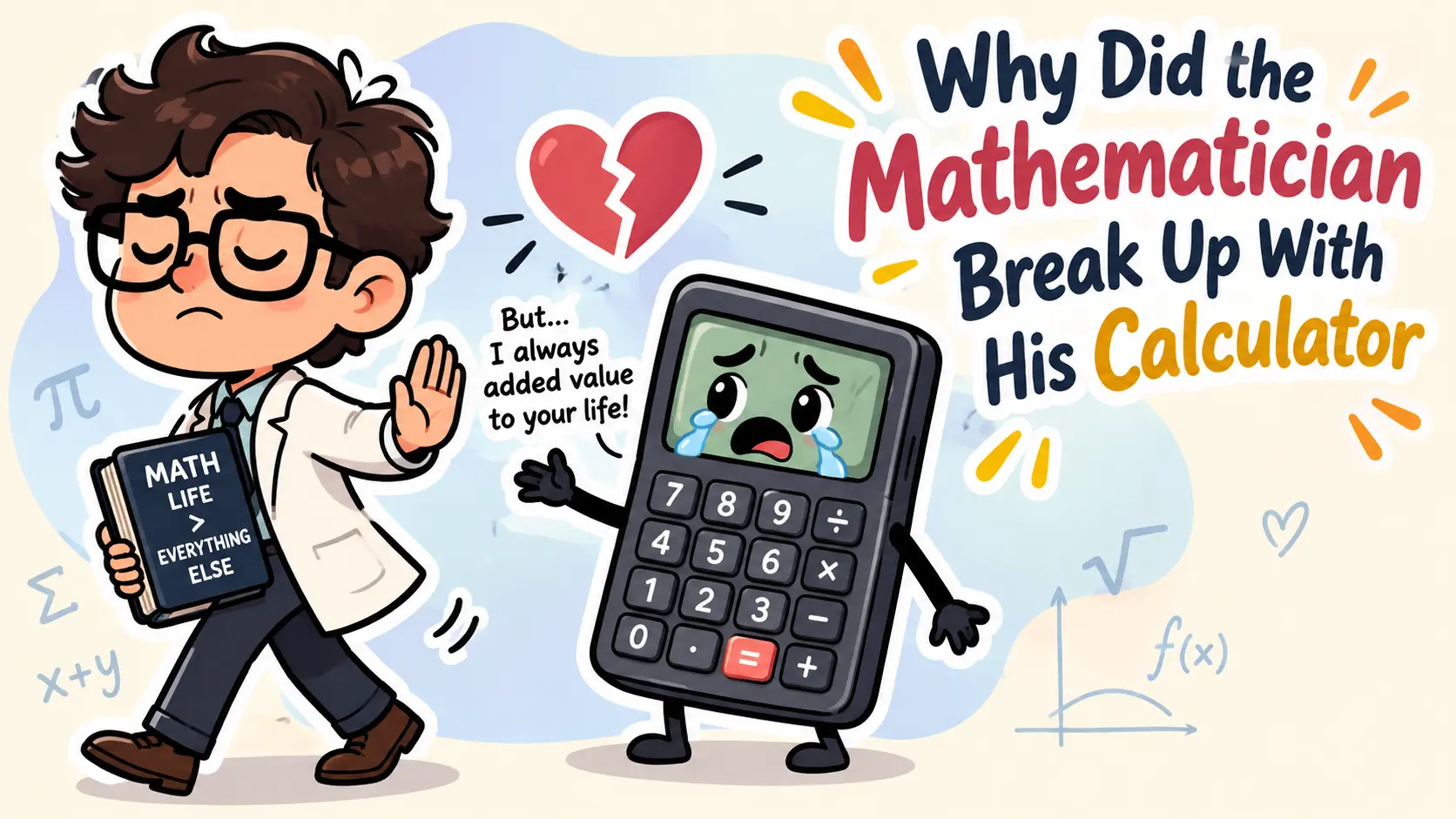
Precision alone has never kept anyone warm at night. A calculator delivers exact answers to every question you throw at it — but ask it how your day was, and you’ll get nothing but silence. That contrast, funny as it sounds, maps onto something researchers in relationship psychology have been measuring for decades: the gap between functional utility and emotional reciprocity in human bonding.
A 2023 study published in the Journal of Social and Personal Relationships found that emotional availability — defined as a partner’s capacity to be present, responsive and empathetically engaged — ranked as the top compatibility factor for long-term satisfaction among adults aged 25 to 45. Precision, reliability and consistency mattered too, but they ranked significantly lower when placed in direct competition with emotional reciprocity. The mathematician’s calculator, by that measure, was always going to lose.
Case for the Calculator and Why It Falls Short
There is something seductive about pure functionality. A calculator never misremembers, never misinterprets and never projects. It gives you exactly what you input, rendered back in clean digits. For a mathematician — someone whose professional life depends on the unambiguous — that kind of reliability feels almost intimate.
But intimacy requires more than accuracy. According to research from the Gottman Institute, which has tracked couples across more than four decades of longitudinal study, partners who consistently demonstrate emotional attunement are 67% more likely to report relationship satisfaction at the five-year mark than those who prioritise practical compatibility alone. The calculator scores zero on attunement. It never notices when you’re tired.
The core disadvantage of a calculator in a relationship context is not that it’s wrong — it’s that it’s indifferent. And indifference, as any emotionally available partner will tell you, is harder to forgive than an honest mistake. At highroller casino, where user experience depends on a combination of precision and genuine responsiveness, the same principle applies: accurate odds mean nothing without an interface that actually meets the player where they are.
Utility Versus Empathy a Side by Side Comparison
The difference between utility and empathy becomes clearest when you map both across real relationship scenarios. One delivers outcomes; the other delivers understanding. These are not the same currency, and they rarely exchange at par:
- A calculator computes your mortgage repayments to the cent — a partner holds your hand while you read the statement
- A calculator never forgets a formula — a partner remembers the formula and why it mattered to you
- A calculator processes input instantly — a partner processes emotion, which takes longer but compounds differently
- A calculator’s output is fixed — a partner’s response adapts based on context, mood and history
- A calculator requires no maintenance — a partner requires consistent investment, which is exactly what makes the return meaningful
That list is not an argument against precision. It’s an argument that precision without empathy is an incomplete product, whether you’re designing a relationship or a betting platform. Highroller casino treats these as complementary values — the accuracy of real-time data paired with a support structure that responds like a human being actually read your message.
Modern Dating Expectations and the Emotionally Available Standard
Dating expectations have shifted measurably over the past decade. A 2024 Pew Research Center survey of over 5,700 adults found that 78% of respondents listed “emotional availability” as a non-negotiable in a long-term partner — up from 61% in 2014. That’s a 17-percentage-point climb in ten years. Romantic compatibility, it turns out, is increasingly defined by what a partner offers emotionally rather than what they provide practically.
This matters for the mathematician joke because the humour lands precisely because everyone recognises the dynamic. We’ve all leaned on something — a tool, a habit, a routine — that delivered results without reciprocity. And at some point, the efficiency stopped feeling like enough. The calculator is better at maths. The emotionally available partner is better at everything maths can’t solve.
The following table compares a calculator versus an emotionally available partner across key relationship dimensions:
| Dimension | Calculator | Emotionally Available Partner |
| Precision | Flawless | Variable but improving |
| Emotional Responsiveness | None | High |
| Adaptability | Zero | Context-sensitive |
| Long-term Satisfaction | Declining | Compounding |
| Conflict Resolution | Not applicable | Active and negotiated |
The table makes the trade-off visible. A calculator wins one column out of five. That’s a 20% win rate in a competition where the stakes are everything.
What Romantic Compatibility Actually Requires
Romantic compatibility versus computational reliability is not a close contest once you define what compatibility actually means. Researchers at the University of California, Berkeley define romantic compatibility as the degree to which two people can regulate emotion together — a process called co-regulation. A calculator cannot co-regulate. It cannot even participate.
The advantage of an emotionally available partner over any precision tool is compounded time. Every shared experience, every moment of attuned response, builds a history that recalibrates the relationship upward. A calculator, used daily for thirty years, is still just a calculator on day ten thousand. A partner, engaged with fully, becomes something exponentially more valuable with each passing year. Sites understand this compounding principle — loyalty programmes and live support are designed around the same idea that responsiveness over time creates something a cold interface never can.